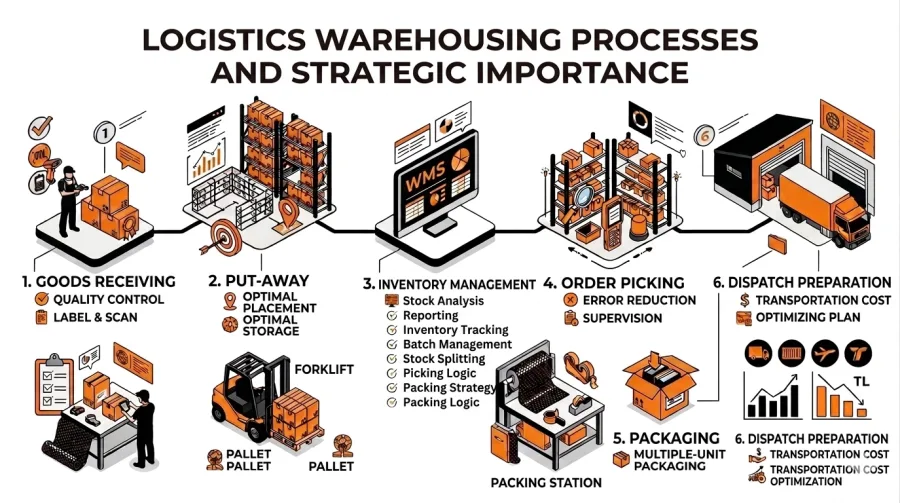
Warehouse processes in logistics form one of the most critical links in the supply chain, ensuring that products are stored under the right conditions and dispatched quickly in line with demand. Effective warehouse management goes beyond simply storing goods — it plays a strategic role in operational efficiency, cost control, and customer satisfaction.
6 Core Operational Stages
Receiving (Product Acceptance)
As the first and most fundamental stage of warehousing, receiving involves rigorous quantity and quality checks of incoming goods. Using accurate recording systems is of great importance for maintaining inventory accuracy.
Errors made at this stage can lead to serious operational disruptions in subsequent steps of the chain. A systematic and careful receiving process is the foundation of a healthy warehouse operation.
Put-away (Slotting & Placement)
The put-away process covers positioning products in the most suitable locations within the warehouse. This requires a balanced evaluation of multiple criteria simultaneously.
The physical characteristics of a product directly determine shelf and space allocation.
Fast-moving items are placed in easily accessible areas, increasing operational speed.
Products with expiry dates are managed using the FEFO rule to prevent waste.
In particular, positioning fast-moving products in easily accessible areas provides significant advantages in terms of operational speed and efficiency.
Inventory Management (Stock Control)
Inventory management is a critical factor for the sustainability of warehousing processes, aiming to balance both the costs of excess stock and the risks of stock shortages.
Increased tied-up capital, wasted space, and risk of obsolescence
Lost sales, customer dissatisfaction, and production stoppages
Through advanced Warehouse Management Systems (WMS), stock movements are tracked and analyzed in real time. This enables proactive decision-making to effectively manage both risks.
Order Picking & Packing (Fulfillment)
These stages directly affect customer satisfaction. Preparing the right product in the right quantity and without damage is one of the key factors that determines delivery quality.
Benefits of Automation Technologies
Shipment Preparation (Outbound)
Shipment preparation and loading processes — the outward-facing side of warehouse operations — form the final link of the entire chain. A well-planned loading process directly contributes to optimizing transportation costs while shortening delivery times.
Conclusion
Effective and integrated management of warehousing processes plays a decisive role in helping businesses gain a competitive advantage. Warehouse management supported by technology-driven approaches, data analytics, and continuous improvement principles has become an indispensable component of modern logistics systems.